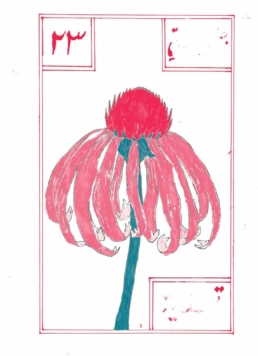
Fi Dar Khalti – Fredj Moussa – BAO Books, Tunis (2025)
Publications
FI DAR KHALTI
Book, co-authored with Alma Chaouchi, Emily Sarsam and Camille Lévy Sarfati, BAO Books, 2025
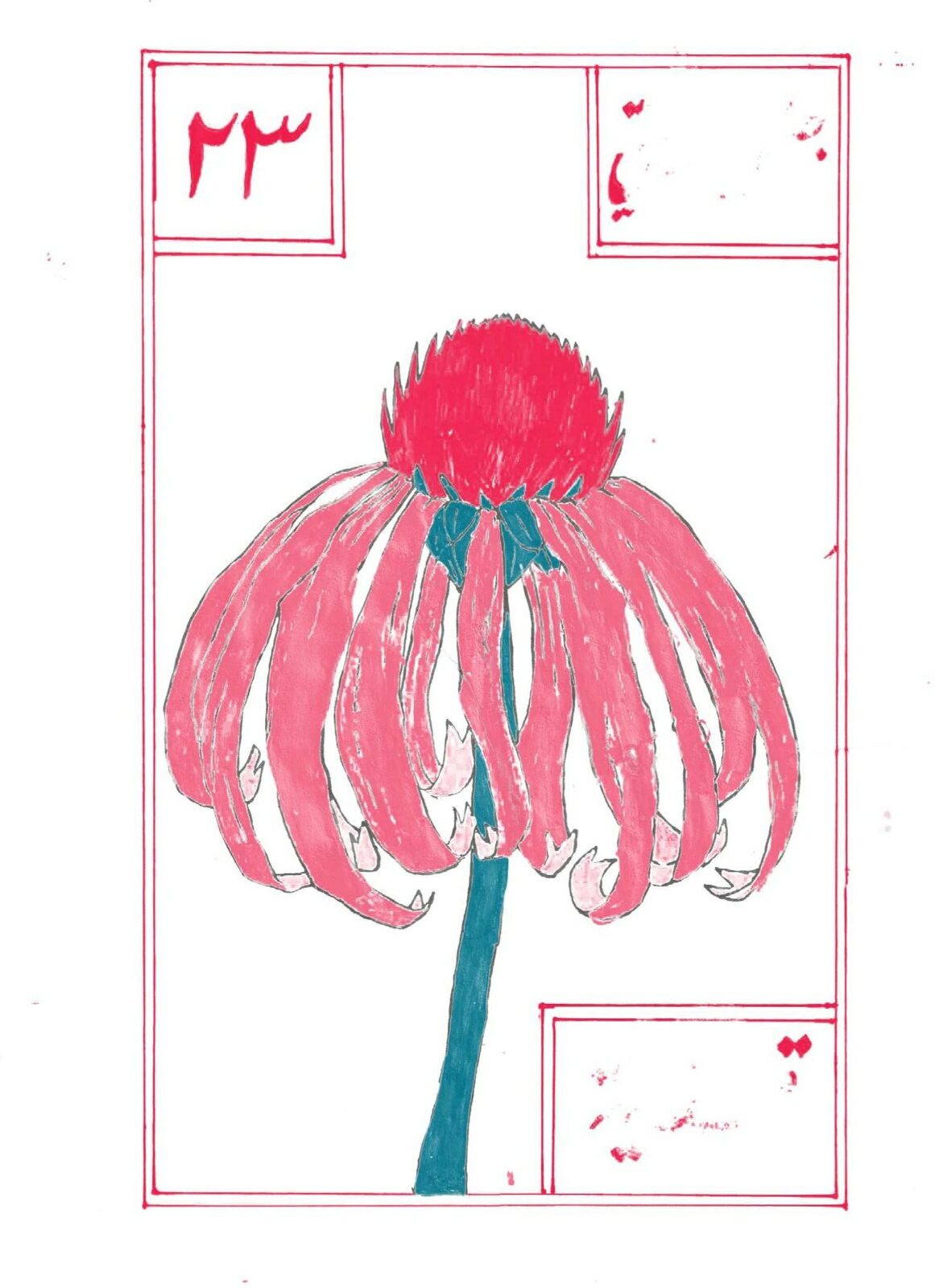
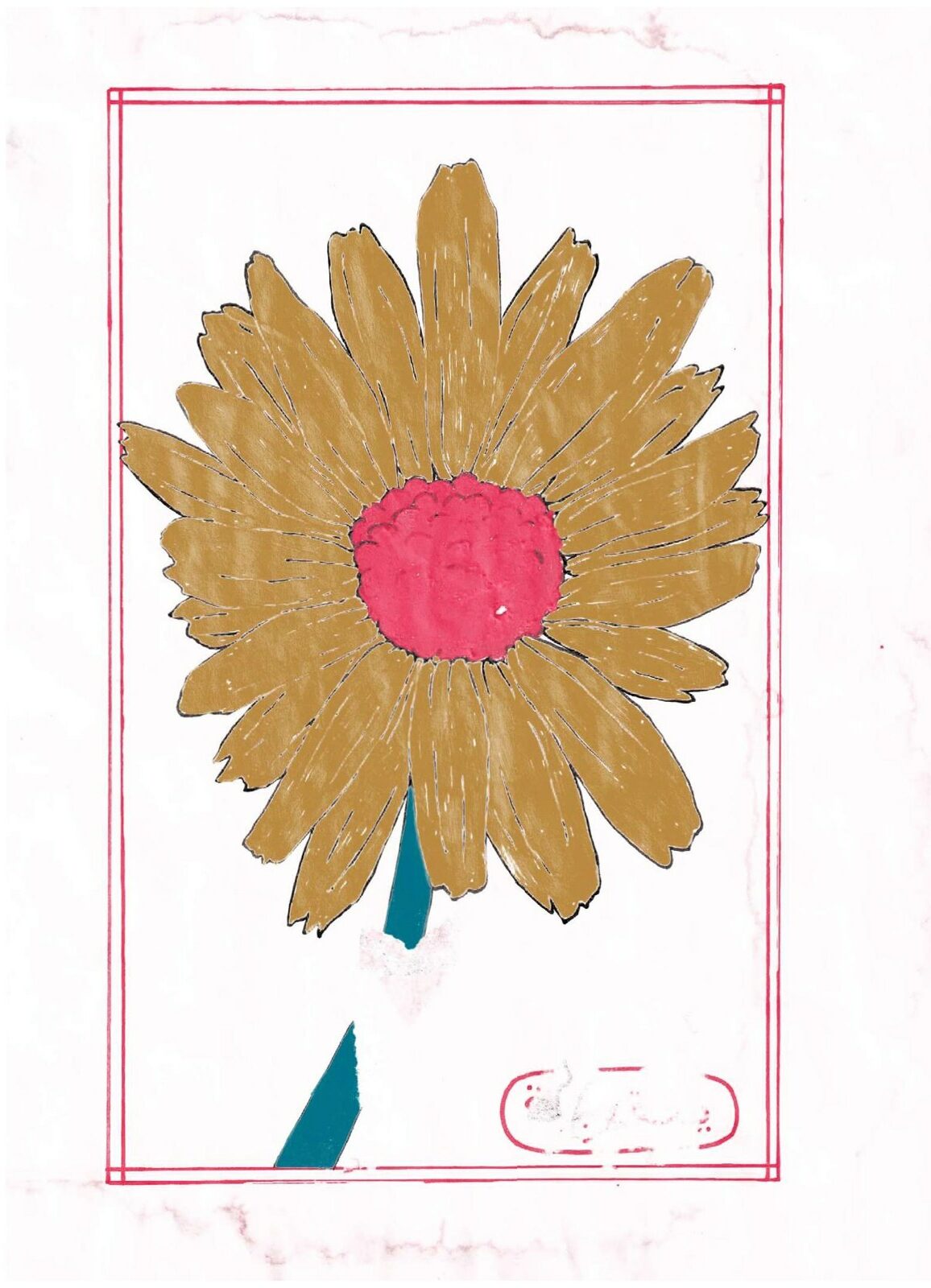
Cover: Fredj Moussa
Fi Dar Khalti is a collective book assembled in Tunisia from fragments of stories and shared gestures, tracing intimate, collaborative experiences within Fi Dar Khalti, solo show of Fredj Moussa.
I contributed with a didascalic, script-like text written from within the workshop process, tracing the sensory and spatial experience of accompanying the artist across residencies at Mouhit and 32bis. It was developed through archival research, conversations and close observation during the preparation of the film The Land of Barbar, later presented at the Berlin Biennale.
Co-authors: Alma Chaouchi, Emily Sarsam, Salma Kossemtini, Camille Lévy Sarfati
Translation: Yasmine Haj
Proofreading: Meriam Gaied
Varnish: Glossy
Graphic & editorial design: Ines Osni
Printing: Sara Bouzgarrou
Distribution: BAO Books
Cover: Fredj Moussa

Jet Lag No.100 – House arrest | إقامة جبرية – Paris Ass Book Fair, Paris (2025)
Publications
JET LAG NO.100 – HOUSE ARREST | إقامة جبرية
Fanzines, Lendroit éditions, mai 2025, Paris Ass Book Fair, Palais de Tokyo, Paris
Jet Lag est une collection éditoriale de fanzines expérimentaux, conçue comme un espace de création, de réflexion et d’édition partagée. Chaque édition se compose de 10 fanzines confiés à 10 artistes ou collectifs, invités à proposer une contribution libre, visuelle, textuelle, fragmentaire, intime ou politique.
Cette édition a été confiée à la scène contemporaine tunisienne. Le point de départ était simple : interroger les formes que prend aujourd’hui la création dans un contexte actuel instable, sous pression. Cette dernière édition est une tentative de saisir un moment, de le lire sous plusieurs angles, d’en cartographier les tensions.
L’enjeu ? Offrir une perspective brute, sans filtre, sur le monde à travers les yeux de celles et ceux qui ressentent l’urgence de s’exprimer, malgré la répression, le doute, la fragilité. Les artistes invité·es répondent par un processus d’observation, d’étude du visible et de l’invisible. Leurs propositions oscillent entre esquisse et réalisation, entre notes personnelles et constats collectifs.
Chaque contribution est une tentative de déchiffrer, du sens des mots ou l’ombre d’un projet en devenir. Loin d’une vitrine, ces fanzines agissent comme un atelier collectif, où les formes se cherchent autant qu’elles s’affirment. Ce ne sont pas des réponses, mais des processus en cours. Ils exposent les outils du travail plus que ses résultats, comme dans le travail de Wafa Lazhari « It’s an unfinished journey like many others. »
Certain·es partent de l’intime, d’une introspection personnelle, comme 3.odwan, avec Lies > Poetry, un espace de satire à décrypter, où le parcours renaissant devient matière à interroger le socio-politique à travers signes, personnages, souvenirs. L’écriture exhume les non-dits, marqués et notés à travers une psyché affirmée, rythmée par les ruptures du quotidien. Ghad Al Majid, quant à iel, cherche au cœur du processus ce qui existe jusqu’à s’en libérer en le dépassant.
D’autres abordent le territoire comme une archive vivante, une matière en transformation à ciel ouvert. Férielle Doulain-Zouari façonne la terre comme une métaphore d’un corps social mis à nu. Les images d’Achref Bettaieb capturent les mutations visuelles de nos espaces publics en perpétuelle métamorphose. Ce qu’El Warcha en fait est tout autre : une relecture, une transgression et une célébration collective de ce que l’espace public donne à voir, un véritable théâtre de situations.
D’autres encore posent des gestes sur l’invisible. Gladone! Bywho! recompose les nouvelles, les médias et nos réalités physiques et virtuelles en un détournement de situation, en un journal tragique : un miroir tendu à une société trop absorbée par son image. Jack Montaly esquisse un langage à venir, un langage qui explore les formes et structures que constitue sa réalité.
Les œuvres de Sana Chamakh et Bochra Taboubi habitent les seuils des corps et des vestiges : entre mémoire et matérialité, entre absence et déconstruction. Chez Sana Chamakh, il s’agit d’une dissection puis d’un ré-assemblage du corps féminin : collage, transfert, dessin en noir et blanc, comme un manifeste visuel anatomique. Elle cherche à recréer, redéfinir et ré-appréhender le corps, entre fascination, distance, tendresse et confrontation.
De son côté, Bochra Taboubi imagine avec Human Abyss une cartographie post-anthropocène. Elle plonge dans les zones abyssales de l’humain où les strates de frustration deviennent sédiments. À mesure que l’on descend, on atteint la black box, système complexe et mystérieux, où l’invisible gouverne l’humain de l’intérieur.
House arrest | إقامة جبرية, un titre décidé collectivement, n’est pas un mot d’ordre, mais une hypothèse : celle d’un enfermement intérieur autant qu’extérieur, une contrainte qui agit sur la forme mais au fond duquel les artistes continuent à créer. Le fragment devient alors stratégie : esthétique de l’inachevé, du pas encore, du peut-être, mais qui bouge, avance certainement. Chaque fanzine devient une carte sensible, une tentative de saisir ce qui circule, résiste, doute, se construit dans leurs pratiques respectives.
House arrest | إقامة جبرية n’est pas là pour offrir des réponses. Il donne à voir ce qui travaille la scène tunisienne aujourd’hui ; montrer le processus devient un geste assumé. Dans un pays où les espaces d’expression se ferment, ces fanzines circulent. Ils relient. Ils tracent. Ce No.100 propose une archive insoumise, en construction, d’une scène qui résiste en créant.
Salma Kossemtini, mai 2025
Artistes : Achref Bettaieb, Bochra Taboubi, El Warcha, Férielle Doulain-Zouari, Ghad Al Majid, Gladone!Bywho!, Jack Montaly, Sana Chamakh, Wafa Lazhari, 3.odwan
Commissariat : Salma Kossemtini
Édition : Lendroit éditions, Rennes
À propos des artistes
Achref Bettaieb, vidéaste et skateur, dont les films, photographies et installations multimédias interrogent les contrastes et complémentarités du comportement humain, les rythmes sociaux et l’interaction entre le visible et l’invisible.
Bochra Taboubi, artiste visuelle et designer de produits, diplômée de l’Institut Supérieur des Beaux-Arts de Tunis. Elle travaille sur la vie artificielle et des créatures fictives qui interrogent l’être humain, à travers dessins, vidéos et installations.
El Warcha, collectif et espace de création fondé en 2016 dans la médina de Tunis, qui promeut l’éducation pratique et l’action civique par la fabrication de mobilier urbain temporaire, d’installations et d’événements publics avec les habitant·es.
Férielle Doulain-Zouari, artiste franco-tunisienne. Par des techniques manuelles, elle interroge les cohabitations entre le naturel et l’artificiel, à travers installations, sculptures et tissages.
Ghad Al Majid, artiste visuel·le basé·e à Tunis (peinture, sculpture, impression, installation), dont le travail explore l’aliénation sociale, les frontières, la transience et la subjectivité queer.
Gladone!Bywho!, Nur Zen, artiste tunisien explorant les mondes physiques et virtuels pour interroger la société contemporaine et ses constructions médiatiques.
Jack Montaly, artiste visuel explorant l’intersection du langage, de la perception et de l’identité, à travers textes, vidéos et images.
Sana Chamakh, artiste visuelle dont la pratique se concentre sur l’égalité des genres et l’expression sexuelle et queer, transformant le corps en théâtre de résilience et de transformation.
Wafa Lazhari, architecte, artiste et cinéaste tunisienne, qui explore la frontière entre réalité et illusion en combinant images réelles et animation 3D. Elle étudie au Fresnoy, Studio national des arts contemporains, depuis 2024.
3.odwan, confectionneur autodidacte d’objets en déséquilibre. Dessin, peinture et sculpture sous contrainte des moyens et des intrusions.
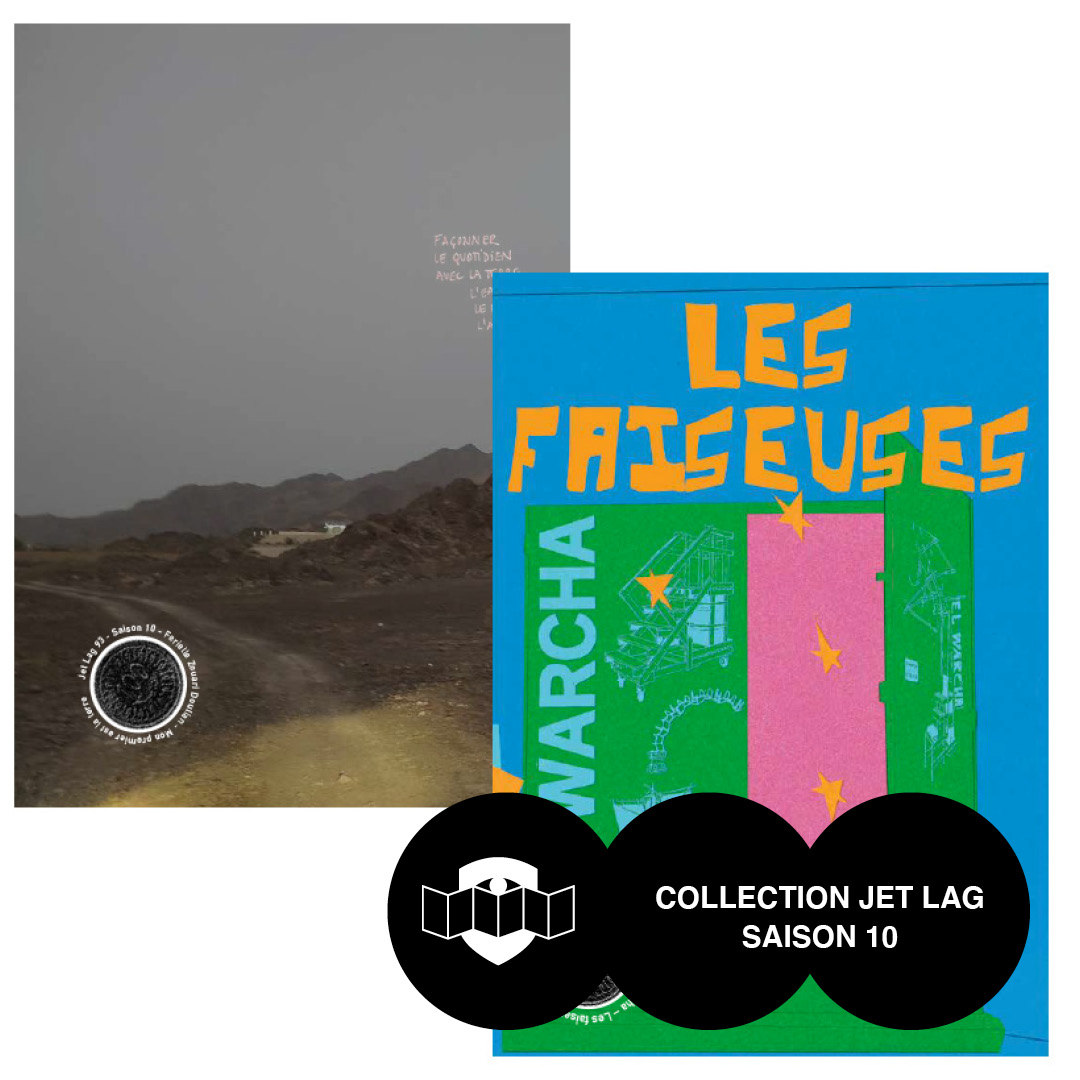
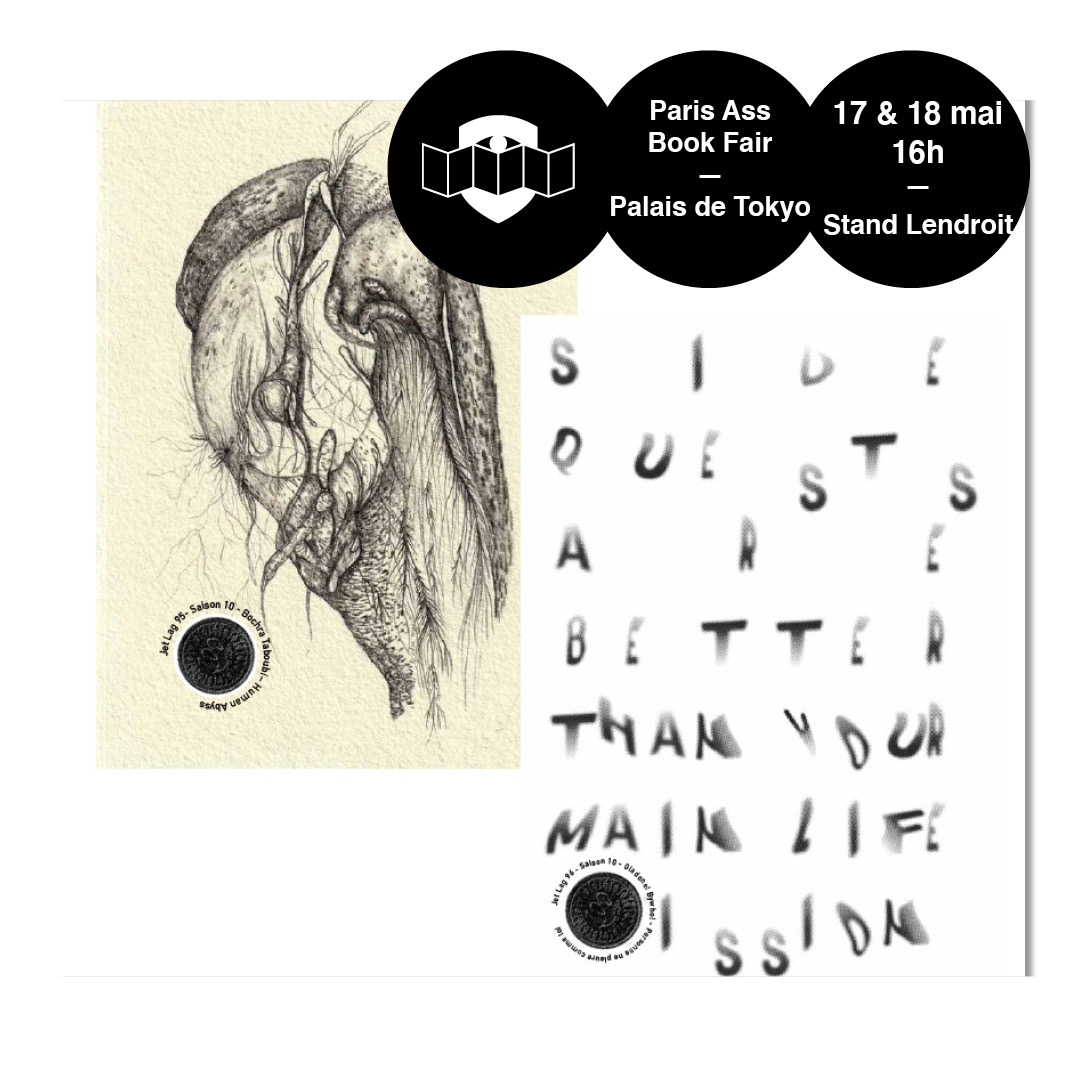
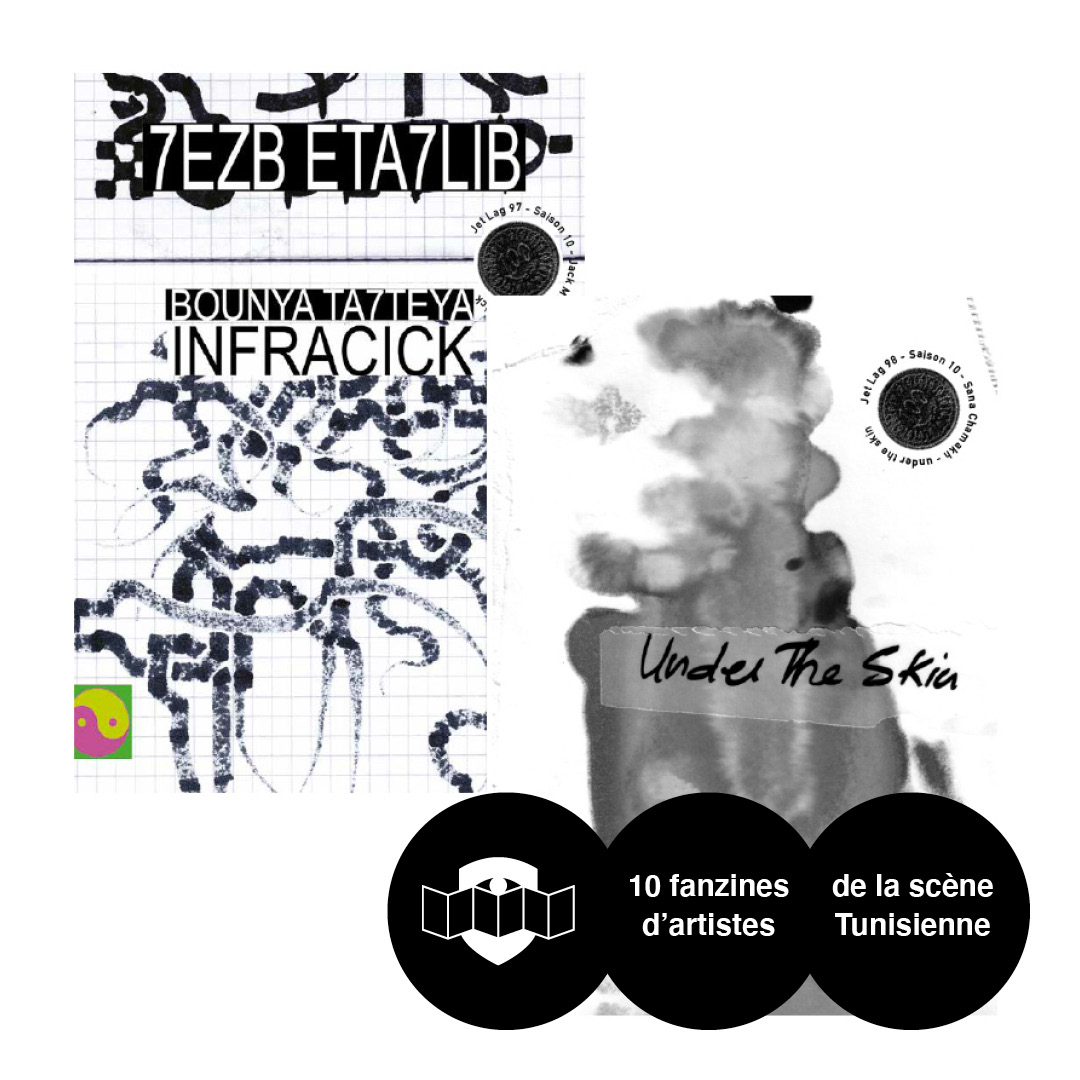
Images : Lendroit éditions
Reclaiming Black Saara’s Legacy – Tuli Mekondjo – Dak’Art, Dakar (2025)
Texts
RECLAIMING BLACK SAARA’S LEGACY
Article, on Tuli Mekondjo’s performance at the Dak’Art Biennale, Dakar, 2024. Performance Art Museum reviews, February 2025
Read the full text on Performance Art Museum ↗
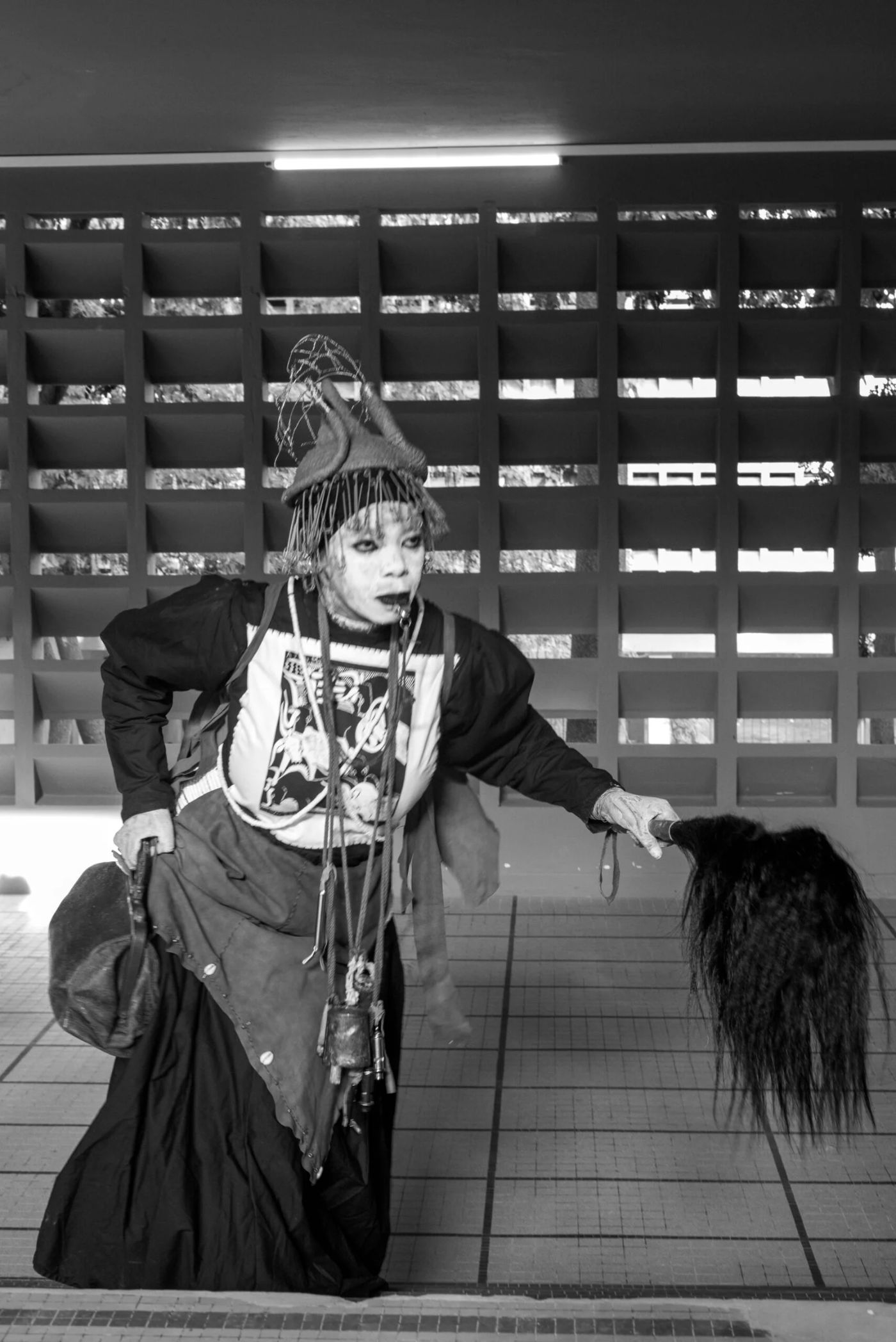
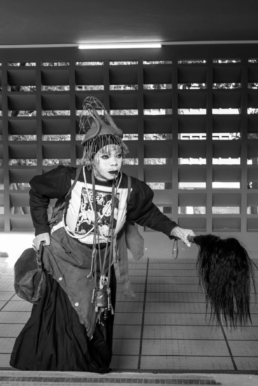
Tuli Mekondjo embodying Black Saara, Dak’Art Biennale, Dakar, 2024. Photo: Pierre de Perouges

Tumadhir’s walk – Nicène Kossentini and Alia Sellami – Selma Feriani Gallery, Tunis (2022–2023)
Tumadhir's walk - Nicène Kossentini and Alia Sellami5 DECEMBER 2022 - 21 JANUARY 2023
Elusive, were the words of Al-Khansa. This faculty that the language had to recompose itself and in its genius, as a kind of tormented wildness where the words escaped each time the meaning and the perceived. There was thus ” a movement of nostalgic, mournful lyricism to reserve, perhaps encode, in short to render both accessible and inaccessible. “
[1] the sense of its words.
The word was the matter for Alia Sellami and Nicène Kossentini. They walked through a reading path, side by side and Tumadhir was their third. They were in the pursuit of an experience, of a journey, they ruminated around a magnetic field where the words orbited around a vibration and a frequency. The verb in action expresses its state whilst it unfolds to the rhythm of the voice tone or the expression of a thought.
From the feminine, they were able to extract, the essence of the expression to invite these various aesthetic and sensory experiences. Seeking various of possibilities to retrieve the thin line between the threshold of the tangible and the perceptible through the voice, the tone, the repetition, the composition, and the meanings of the reading.
“Being at the limit: these words do not yet form a proposition, let alone a discourse. But there is there, provided that one plays of it, of what to generate more or less ” [2]
The poetic experience through a language open to interpretation, to a musicality of a fertile ground of the imaginary of whose perceiving it.

Plural, such was the qualification of the verb. It brings together distinct temporalities freed from the formal constraints and multiplied to give a quaternary sense for it. The verb becomes a state or a plastic expression in itself, in a performative kind. The word is put into action and reaches you by a gesture, sometimes repetitive, written or heard.
Like a life journey, Kossentini and Sellami were able to pursue what these words had to offer in the quest for ” the literary character of the text is inscribed on the side of the intentional object, in its noematic structure, one could say, and not only on the subjective side of the noetic act. “[3]
The process was interwoven with ante-Islamic poetry, which served as a breeze to tickle the artists’ senses to essentially extract an existence of its own from each verb. They began thus to think a language in movement.
Working with the spoken, rehearsed, mouthed, spelled language and at the same time intensified, as a material that mastered mainly the work by directing Nicene’s hand in her visual compositions and Alia’s breath to breathe her words.
In total harmony, both led the orchestra, they composed, sometimes taking over the reins by intuition, to the same degree of sensitivity and synchronicity.
Step by step, Kossentini and Sellami let themselves be guided by what the words made them undergo and communicate to them the matter of the plethora of possibilities in perceiving the reading journey of a word.
From a thought, they accessed the language through the sensory that led to a common root that could grow different branches, graphically and what it conveyed vocally as a meaning.
The sound is lived and sensed just like the written word, black on white, or what could be qualified as “the metaphysical exchange, the circular complicity of the metaphors of the eye and the ear. “[4]
Tumadhir’s walk is an exhibition that combines the mouvement of poetry, the essence of poetics, the sound and a meeting point of plastic and performative expressions that found their way through terms and vibratory means. The word becomes matter, a gesture, a life span and a musicality that has no limit to arouse the senses and to attain them.
Salma Kossemtini, Selma Feriani Gallery Tunis, November 2022
1. Derrida,J. (1992) Acts of litterature, Editions Routledge, p35
2. Derrida,J. (1972), Margins of philosophy, the University of Chicago, les editions de minuit, p1
3. Derrida,J. (1992) Acts of litterature, Editions Routledge, p4
4. Derrida,J. (1972), Margins of philosophy, the University of Chicago, les editions de minuit, p13


La Flamme Germe – Yazid Oulab – Selma Feriani Gallery (2022)
La Flamme Germe - Yazid Oulab
24 FEBRUARY - 23 APRIL 2022In conversation with Yazid Oulab
A pictorial connection to learning
Growing up in the arms of his grandmother, the first vision Yazid Oulab opened his eyes to were the Amazigh symbols inked onto her skin. She was the cave and cradle that introduced him to this image in his early years. Having grown up surrounded by lines, dots and their intersections, his relationship to learning was quite complex but strongly pictorial and imaginative. The image was built and anchored in his retina long before he went to art school, which he joined at the age of twenty-two. And what if letters were indeed drawings? An “A” could be a fish with a missing dot and the “B” is the unison of two rings and a line.
His path was by no means random, defined from his maternal cradle, to the elementary school where he perceived form and geometry, to the school where he learned to draw and paint full time. He gave himself the means to drive his learning well from Algeria, Paris and then Luminy in Marseille; a rather familiar context for a person who grew up in the countryside with an eye that carries very far.
Approaching the sphere, the cone and the cylinder
As soon as Oulab arrived in France, he began to question concepts, to reflect on the poetics of things, on their primary and figurative meaning.
He was asked the question “how do you express yourself through a tree?”. This was the starting point of reflection upon where he comes from, his context and the beginning of everything. The answer holds genealogical roots that later become the foundation of his formal research.
Coming from a family that is both intellectual and working class, his upbringing joins together poetry and work. If he were to symbolize this with an image; then he has simply found the nail that brings writing and labor together. A link, an anchor and a fixture that allows him to hang on to the universal art history.
“What is interesting about the nail is that it draws from the history of art and the energy of creation. Cézanne, the father of modernity, thought that nature should be treated by the sphere, the cone and the cylinder. And if these objects were put into action; The sphere can inscribe the curve, the cylinder when laying draws a line and the cone when it turns draws a circle.”
From the line to the curve to the circle, Oulab thus draws from a pillar of his Arab-Muslim culture, the Koran that he considers as a literary and scientific reference. More specifically, he draws from a fundamental surah which begins with “Alif, Lam, Mim”. These letters are outlined from the cone, the cylinder and the sphere, just like the nail. “And if we contemplate all this, we would have understood everything. I only notice the forms and the gesture of the creators. What interests me is to always go towards the source and the beginning.”
To ponder the object in gesture and geometry; such was Oulab’s approach to his works. He contemplates the gesture in the literalness, expressing and making an expression. These go hand in hand in his approach. Based on his culture which places importance on action and literature, he draws a link anchored by a nail of the cuneiform writing towards the gesture of the worker who builds with his tools where the tool itself is , object and subject of creation. From the hollow writing with a drill on a fragile paper or barbed wire tracing words, he blurs the use of rough materials in installations that draw up the relationship between the signifier and the signified.


La flamme germe
La flamme germe carries its roots in the bud of an event that shook the universe, in an invisible gesture that decided the course of the earth. At the moment of standstill, nature only returns to itself, to bend and to search in its core.
Searching for the source of everything, Yazid Oulab turned to the quantum theory; the idea that the universe began as dimensions folded to one moved the artist to retrace the beginning and to find the source. In his quest for the core, Oulab studied the history of art beginning from the traveling monks that carried their manuscripts preserved by leather pouches. The intellectual object containing the most fragile first drafts, was always preserved by a protective layer and carried like a bundle.
The foundation of Oulab’s work lies in questioning the literalness of gestures and their interactions. The object that travels and serves to receive the reflection of its holder is always buried under a thousand folds of words, letters and protected by fabric. Always in a dichotomous ratio to the wrapped object and its envelope, the Persian miniature was wrapped by the painting. By deploying the relationship of cause to effect, the work of the earth is done with tools. If the tools germinated from the earth itself, the body of work becomes itself made of the material that constitutes it.
The flame rises from the germination, sprouting the tool and the tool becomes matter to think and matter to create. The text in our case serves as a seed, a fundamental element in our culture which at the base rises from letters, from “Alif, Lam, Mim”. “It’s the way we think about writing, it’s like the whole universe is made of string, according to the string theory. Writing is like thin lines, little strings where words and sentences are enclosed in the universe.”
In the same vein, the energy of creation or even the quantum phenomenon draws up meaning, the original and intellectual flow. Preserved by this layer of paint, not to adorn it but to envelop it and give it meaning from its external image without the need of pointing a direction, but rather from a radical gesture like a worker who with a firm one defines the signified object.
This text is the fruit of a conversation with Yazid Oulab around his personal exhibition “La flamme germe, 2022” , Salma Kossemtini

5 collectors, 5 rooms – Pascal Hachem – Selma Feriani Gallery (2021)
5 collectors, 5 rooms - Pascal Hachem8 October - 30 November 2021
Context is a key element as any reflection of Pascal Hachem; anchored in his specific environment. Drawing from the Lebanese political and social fragility and the economic disintegration that the country is enduring and exposing the chaos post-explosion and pandemic in a Tunisian framework where transitions never cease to surprise since the revolution. This environment positions the artist in various situations to question several issues and dynamics in the art scene, ranging from museums, the collection and the artwork itself.
Collecting artworks and designing a collection; such is embedded in an evolving process that is built as a whole. It carries shapes and forms giving meaning to the collector’s perspective and outline on the world. The artworks meet their state, by either triggering thoughts or mirroring their mindset. As Hans Ulrich Obrist states ” in collecting, you’re making an artwork too which is composed of different specific pieces. How you’ll design your artwork is entirely up to you and not what other people think.”
The exhibition “5 Collectors, 5 Rooms” was triggered from this anchor point, questioning the practice of collecting, the position of the artwork and by exploring these limits in reversing the roles. What if collecting meant shaping? What would be a work reflected with the participation of its collector?
Pascal Hachem’s body of work addresses five collectors from different contexts and countries through virtual exchanges, where the conversation leads the way. He sets milestones according to the context of his interlocutor and his own, giving free reign to exchanges to lead, break, criticize and question the becoming and being of the work.
To transform the ideas into a matter of reflection, such is the journey carried out jointly with the collectors through the discussions.
In an arrangement of five separate rooms within the Selma Feriani Gallery, Pascal sets up five distinct experiences reflecting the fruit of the discussions conducted.
By finding common ground within the conversations, Hachem uses the different backgrounds of the collectors as a medium to build performative acts staging the reflections in dynamic objects dealing with the material and immaterial aspects.


From the several encounters, the displayed works come as a result of a keen journey of ex- change, to shape means laying down means of representation, reflection or even dichotomy.
Among the topics addressed, borders happen to appear as a definition of the familiar and unfamiliar spaces, in the process of transformation by exceeding and changing definitions. One of the works equally stages the thin yet empowered line between women and words that rule with soft power, soft as lace on aggressive tools.
The set-up juggles between analogies positioning political situations and social figures. The former is visible through the most subtle and hid- den aspects using food and its impact to impose a dictatorship. The study of Etel Adnan’s “The Weight of the World”, suggests a contemporary perspective of the Lebanese context confronting two temporalities and points of view on the situation.
The exhibition offers five windows in which the viewer can position themself in front of various situations, bearing in mind the collection as a background skeleton and the topics addressed in a socio-political dialogue of the respective contexts.
Drawing from banal, everyday life objects, Hachem adopts the tone set by the conversation and translates it into live sculptural installations. He studies the material per the sensory emotions that it carries, ranging from local cigarette packets to heavy anvils to the delicacy of blown glass.
Each work mirrors the open process and echos the different mindsets of new acquaintances giving space to an open window for furthering questions out of the physical experience.
Salma Kossemtini, Selma Feriani Gallery Tunis, September 2021

Al Moutawassit: Cultural Mediation as a meeting point – Manifesta 13, Marseille (2020)
Al Moutawassit: Cultural Mediation as a meeting point
Al Moutawassit: cultural mediation as a meeting point publication is the result of Manifesta 13 Tiers Programme project, the autumn school for young professionals working in the fields of contemporary art, formal education, research, and social action in Algeria, France, Morocco, and Tunisia. The publication is composed of three parts. The first is devoted to commissioned texts that contextualize what is understood as audience engagement and education in the different national perimeters participating in Al Moutawassit project. The second part of the publication documents the work of the twenty-one participants. They worked in groups on four thematic approaches to education and outreach: decentring and decolonising knowledge(I was part of it); situated, territorialised mediation; questioning methodologies; and institutional analysis and power relations within institutions.
You can read my contribution : p124 – 125

Malek Gnaoui: The Elastic Mind – Selma Feriani Gallery, Sidi Bou Said (2020)
Texts
MALEK GNAOUI: THE ELASTIC MIND
Article, with Syrine Siala, on the exhibition Essaida Carthage by Malek Gnaoui, Selma Feriani Gallery, Sidi Bou Said. TASAWORAT, 2020
Read the full text on TASAWORAT ↗
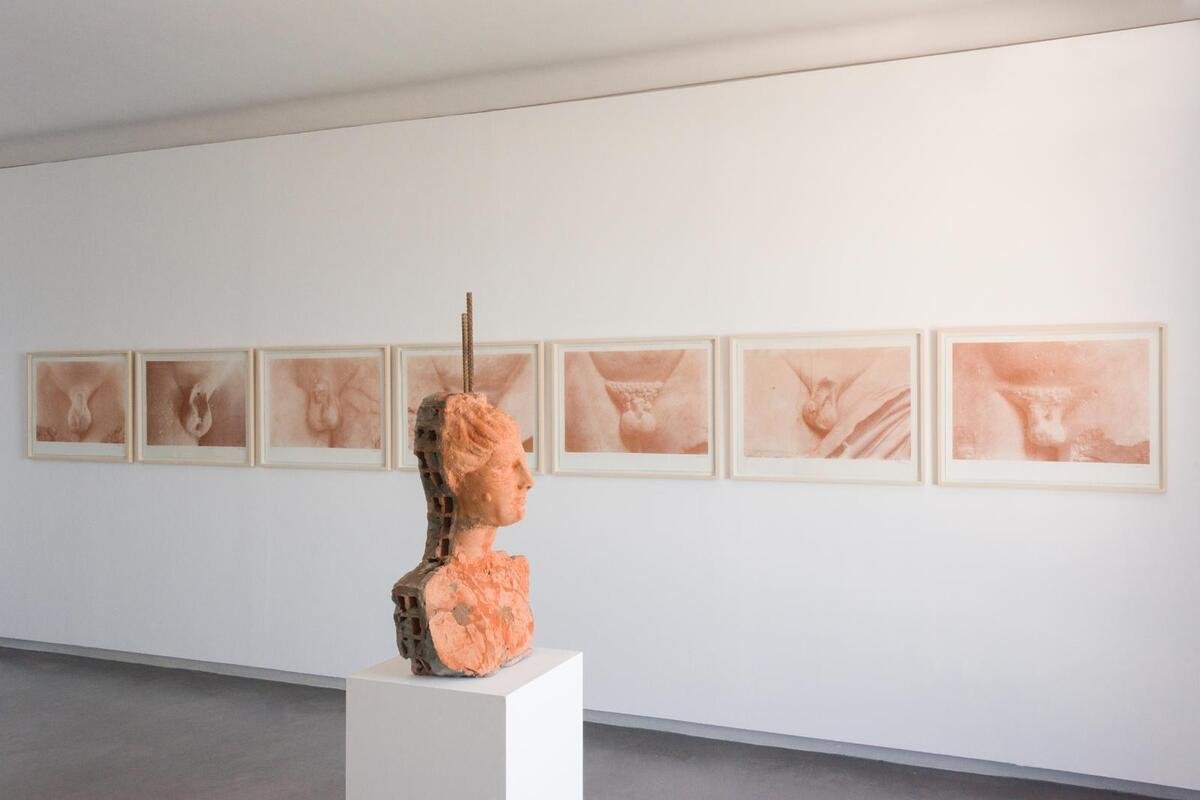
Malek Gnaoui, SC20/broken, Selma Feriani Gallery, Sidi Bou Said, 2020. Photo: Selma Feriani